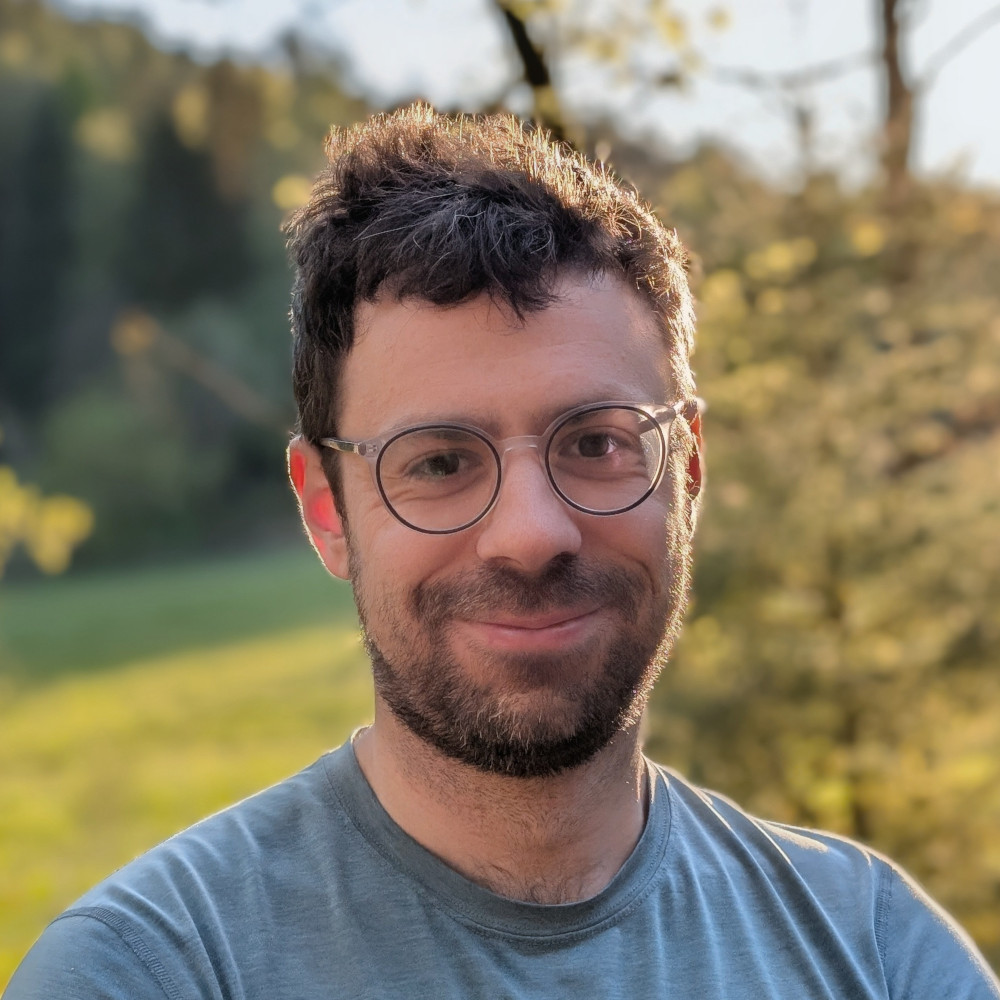
About me.
Hi, I’m Markus. I’m passionate about exploring new ideas in computer science – and sharing that passion through teaching. I’m a substitute professor (W2) for theoretical computer science at RPTU Kaiserslautern-Landau (2025-present). Previously, I was a postdoctoral researcher at KU Leuven with Bart Bogaerts (2024-2025). I did my PhD with Pascal Schweitzer at TU Darmstadt (2019 - 2024).
My research interests, broadly.
- symmetry detection and exploitation
- Boolean satisfiability
- combinatorial algorithms
- certifying algorithms
- algorithm engineering
Symmetry in Practice.
Symmetry is everywhere.
In mathematics, we often intuitively exploit symmetry by, for example,
invoking “without loss of generality” arguments.
Looking at the equation x^2 + 2xy + y^2, we can see that x and y play symmetric roles,
and shorten our discussion accordingly.
Algorithms cannot intuitively do so on their own; we need to carefully design them to exploit symmetry.
Two complementary research interests of mine are algorithms to detect symmetry and algorithms to exploit symmetry. In both cases, I study practical algorithms and mathematical insights into these practical algorithms. Symmetry detection is closely related to the graph isomorphism problem, and has natural ties to algorithmic group theory. Symmetry exploitation, on the other hand, involves adapting existing algorithms, such as in Boolean satisfiability or mixed-integer programming.
Concretely, together with Pascal Schweitzer, I developed dejavu, the fastest tool for combinatorial symmetry detection, based on several new theoretical insights. With Sofia Brenner and Gaurav Rattan, I developed satsuma, an algorithm that exploits symmetry in the Boolean satisfiability problem, which successfully speeds up the fastest SAT solvers.
Research software.
My research involves designing and investigating the limits of practical algorithms. All my algorithms are available as open source software with liberal licensing. I try to take care of these tools as much as I can, and I want them to be easy-to-use in practice. Hence, I’m always happy to get feedback if you happen to try them out.
- dejavu (2019-present)
state-of-the-art solver and library for the detection and manipulation of symmetry
used in SCIP
-
satsuma (2024-present)
modern symmetry breaking for Boolean satisfiability testing🏅 winner in main, SAT, and UNSAT track of SAT Competition 2026 with Kissat
🏅 winner in parallel and cloud track of SAT Competition 2026 with MallobSat
🏅 winner in certified tracks of PB Competition 2025 & 2026 with RoundingSat
- sassy (2023)
preprocessor for symmetry detection, now subsumed into dejavu
I have also in some way contributed to the development of the following software:
- VeriPB (2025)
proof-checker for VeriPB proofs
Peer-reviewed Publications.
Selected Other Publications.
Teaching.
As lecturer with full course responsibility:
- Algorithms and Data Structures at RPTU Kaiserslautern-Landau, 2026
- Algorithm Engineering (Seminar) at RPTU Kaiserslautern-Landau, 2025/2026
- Algorithms and Satisfiability at RPTU Kaiserslautern-Landau, 2025/2026
- Algorithms and Data Structures at RPTU Kaiserslautern-Landau, 2025
As assistant:
- Propositional and First-order Logics at TU Darmstadt, 2024
- Automata Theory and Formal Languages at TU Darmstadt, 2022
- Algorithms and Symmetry at TU Kaiserslautern, 2020
- Algorithms and Data Structures at TU Kaiserslautern, 2020
- Complexity Theory at TU Kaiserslautern, 2019
As student assistant:
- Algorithmic Group Theory at TU Kaiserslautern, 2019
- Computer Systems at TU Kaiserslautern, 2018
- Design and Analysis of Algorithms at TU Kaiserslautern, 2016